CENTAURIA DILUTA subsp. DILUTA
Family and Genus:- See- COMPOSITAE
Common Name:- Lesser star-thistle, North African knapweed.
Homotypic Synonyms:- None
Meaning:- Centaurea (Gr) Centaur, Centauros. The centaur Chiron was cured of a
hoof wound with this plant.
Diluta (L) Pale, washed-out.
General description:- Perennial.
Stem:-
1) Up to 50 cm, erect, simple proximally, openly branched distally, glabrous or
thinly hairy.
Leaves:-
1) Leaves, thinly pubescent.
2) Basal and proximal cauline, petiolate;
a) blades, 10-15 cm, margins coarsely pinnately lobed.
3) Mid cauline, sessile or short-petiolate, short-decurrent,
a) blades, obovate or narrowly oblong, 2-8 cm, entire to pinnately lobed.
4) Distal cauline, oblong, entire to irregularly lobed.
Flowers:-
1) Heads, radiant, in open cymiform arrays, pedunculate.
2) Involucres, ovoid, 8-15 mm diam.
3) Phyllaries;
a) principal, bodies, greenish, ovate, scarious-margined, appendages
stramineous to brown, scarious, fringed with slender teeth, tipped by slender
spines 1-5 mm.
b) innermost, unarmed with brown, expanded, lacerate appendages.
4) Florets, many, corollas pink-purple, those of
a) sterile, 25-30 mm, enlarged, raylike, those of
b) fertile, ± 20 mm.
Fruit:-
1) Achenes.
a) inner, with the pappus as long as the achene.
b) outer, with a very short pappus.
Key features:-
Habitat:- Often found in subtropical, dry, or cultivated habitats.
Distribution:- Native to, Azores, Canary Is., Madeira, Morocco, Spain.
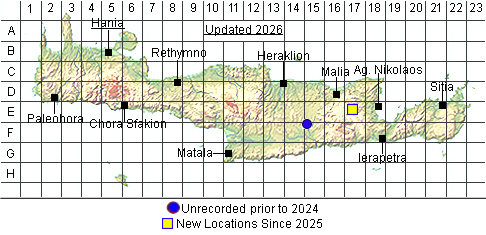
Previously unrecorded from Crete, discovered by Popi Bormpoudaki in May 2024
near Mousouta, with a further find on Katharo by Christopher Cheiladakis & Steve
Lenton in June 2025
Flowering time:- April to June
Photos by:- Popi Bormpoudaki
SPECIES DESCRIPTION